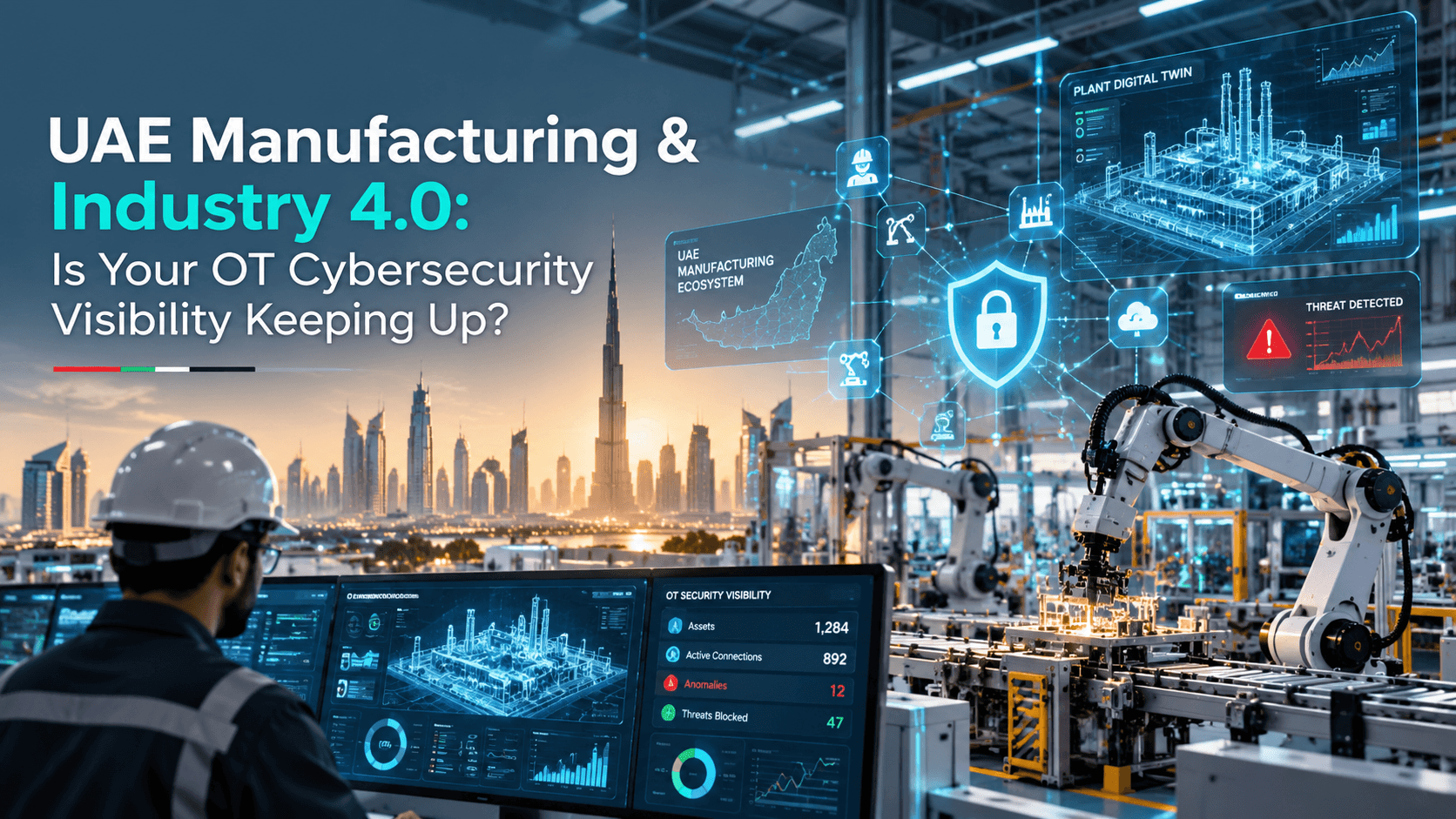
Industrial organizations have always planned for equipment failures, operational risks and unexpected downtime. Today there is another challenge that can disrupt operations just as quickly: cyber threats targeting Operational Technology (OT). This blog post discusses the multiple advantages of using an integrated cybersecurity solution, as well as its effectiveness in combating changing cyber threats.
A cyber incident in an industrial environment can do far more than interrupt production. It can delay shipments, affect worker safety, disrupt customer commitments and quickly become a board-level concern. According to the World Economic Forum's Global Cybersecurity Outlook 2026, 72% of organizations report that cyber risks have increased over the past year, driven by AI adoption, geopolitical instability and increasingly interconnected digital environments. As industrial operations continue to connect with enterprise systems, these risks are no longer confined to IT. They directly affect operational resilience and business continuity.
This is why OT security is no longer simply an engineering or IT responsibility.
For CISOs, CEOs and operational leaders, it has become a strategic business priority. The question is no longer whether an attacker can be blocked. It is whether suspicious activity can be detected early enough to prevent operational impact.
OT Visibility Has Become a Leadership Priority
Operational Technology has traditionally been managed as a specialist engineering function, with cybersecurity acting as a supporting capability. That approach is becoming increasingly difficult to sustain.
Manufacturers and critical infrastructure operators are connecting enterprise IT, remote access, Industrial IoT, cloud platforms and digital manufacturing initiatives to improve efficiency, productivity and operational visibility. While these initiatives create measurable business value, they also expand the attack surface.
Unlike enterprise IT incidents, attacks targeting OT environments can simultaneously affect production quality, worker safety, operational availability and customer trust.
As a result, executive leadership is asking different questions:
- How quickly would we know if an attacker entered our OT environment?
- Could we identify reconnaissance before production systems were affected?
- Which assets represent the greatest operational risk?
- How can cyber resilience be improved without disrupting production?
These are business questions as much as security questions. Organizations do not simply need more security tools. They need earlier visibility and greater confidence in the signals they receive.
This direction is reinforced by globally recognized guidance including NIST SP 800-82 Rev. 3, NIST Cybersecurity Framework 2.0, IEC 62443 and ISO/IEC 27019, all of which emphasize continuous visibility, risk-based protection and operational resilience across industrial environments.
Why Traditional Detection Leaves Blind Spots
Protecting Operational Technology has never been the same as protecting enterprise IT. NIST SP 800-82 Rev. 3 highlights that OT systems directly monitor and control physical processes where safety, availability and reliability are primary operational requirements. Many industrial environments continue to rely on legacy systems, limited maintenance windows and communication protocols that were never designed for today's cyber threat landscape.
Traditional security controls remain essential, but they often face limitations inside industrial environments. They may generate excessive alerts, struggle to interpret OT-specific communications or overlook reconnaissance and lateral movement that appear legitimate within industrial networks. Most importantly, they often identify threats only after attackers have already established a foothold.
This creates a critical visibility gap where attackers gain valuable time while defenders receive little actionable insight.
A Smarter First Signal
Modern OT security requires more than monitoring. It requires earlier detection.
This is where deception technology adds an important layer of defense.
Rather than attempting to monitor every asset equally, deception deploys realistic industrial decoys that appear genuine to attackers while remaining completely isolated from production systems. Any interaction with these assets immediately signals suspicious activity because legitimate users have no operational reason to access them.
Instead of waiting for operational disruption, security teams gain visibility during reconnaissance when attackers are still exploring the environment. The result is a stronger first signal that enables earlier investigation, faster containment and more informed response.
How ZeroHack Trace OT Supports Modern OT Security
ZeroHack Trace OT applies deception technology specifically to Operational Technology (OT) environments.
It creates realistic industrial decoys that emulate assets attackers actively search for, including PLCs, SCADA systems, HMIs, engineering workstations and industrial services. When attackers interact with these decoys, Trace OT transforms that activity into actionable intelligence without introducing intrusive monitoring across production systems.
Purpose-built for industrial environments, Trace OT combines deception-based detection, deep packet inspection for OT traffic, self-healing sensors and deployment flexibility, including support for air-gapped networks.
Rather than operating as an additional monitoring tool, it becomes an intelligent early warning layer that complements existing OT security investments. Its value extends beyond technology. It strengthens operational resilience.
Earlier Threat Detection
Detect reconnaissance and suspicious activity before attackers reach production systems, providing valuable time for investigation and response.
Visibility into Lateral Movement
Reveal how attackers move across industrial networks and identify potential attack paths before critical assets are affected.
High-Confidence Detection
Interactions with deception assets are inherently suspicious, reducing false positives and enabling SOC teams to focus on genuine threats.
Operational Continuity
Improve visibility while preserving system stability, making the platform suitable for environments where safety, availability and uptime cannot be compromised.
Why This Matters to CISOs and CEOs
Cyber resilience is increasingly measured by how quickly organizations detect and understand threats rather than by the number of security tools they deploy.
For CISOs, earlier detection supports improved Mean Time to Detect (MTTD), stronger incident response and better alignment with governance and compliance objectives.
For CEOs and COOs, the focus is even more practical.
Can operations continue safely during a cyber incident? Can security investments strengthen resilience without disrupting production?
These are the outcomes that matter to executive leadership.
According to the IBM Cost of a Data Breach Report 2025, the global average cost of a data breach has reached approximately USD 4.9 million, highlighting that the financial impact of cyber incidents extends well beyond technology. For industrial organizations, production downtime, operational disruption and reputational damage often represent even greater business risks.
ZeroHack Trace OT supports these objectives by providing earlier visibility, actionable intelligence and greater confidence in environments where every minute of operational downtime matters.
Why OT Security Demands a New Approach
Industrial cybersecurity continues to evolve alongside digital transformation.
IT and OT convergence continue to accelerate. Remote operations are becoming standard practice. Critical infrastructure is becoming increasingly connected. Every improvement in connectivity creates new opportunities for efficiency and innovation. It also introduces new cyber exposure.
Organizations that wait until production is affected have already lost valuable response time. A stronger security strategy assumes reconnaissance will occur and prepares the environment to detect it as early as possible.
This is why deception technology is becoming an increasingly important capability within modern OT security architectures.
Building Stronger Industrial Resilience
The strongest OT security programs are built on visibility.
They understand critical assets.
They identify meaningful threats.
They enable informed decisions before operational disruption occurs.
ZeroHack Trace OT helps organizations strengthen these capabilities by providing earlier visibility into attacker activity, reducing uncertainty and improving cyber resilience across industrial environments.
For manufacturers, energy providers, utilities, pharmaceutical companies, logistics organizations and other operators of critical infrastructure, this level of visibility is becoming essential rather than optional.
The Future of OT Security Starts with Visibility
Industrial cyberattacks rarely begin with disruption.
They begin with reconnaissance.
Organizations that build resilience are not those that simply respond faster. They are the organizations that detect earlier.
ZeroHack Trace OT enables security teams to identify suspicious activity before it reaches production systems, helping improve threat detection, strengthen operational resilience and reduce business risk.
As industrial environments become increasingly connected, early visibility is no longer just another security capability. It is becoming a business necessity.
Discover how WhizHack's ZeroHack Trace OT helps organizations improve OT visibility, detect threats earlier and strengthen operational resilience.