UAE Manufacturers Are Racing Toward AI and Industry 4.0. Is Their OT Cybersecurity Visibility Keeping Up?
Blog / 4 min read

The next industrial security challenge is not simply finding vulnerabilities. It is understanding what they mean for the operation. This blog post discusses the multiple advantages of using an integrated cybersecurity solution, as well as its effectiveness in combating changing cyber threats.
The factory of the future is no longer simply automated. It is connected. AI, robotics, industrial IoT, automation and advanced analytics are changing how manufacturers operate. Production systems increasingly interact with enterprise applications, remote-access channels, vendors and other digital infrastructure. These connections improve productivity, efficiency and decision-making, but they also create a more complex environment for security teams to understand.
For the UAE, this transformation is already well underway.
Through Operation 300bn and the Ministry of Industry and Advanced Technology’s (MoIAT) Industry 4.0 and Technology Transformation programmes, the UAE is actively accelerating industrial digitalisation. Factory Forward UAE, launched in 2026, brings related industrial transformation initiatives together. Official figures indicate that more than 700 factories have been supported, including over 620 assessed through the Industrial Technology Transformation Index. The national direction is clear: UAE manufacturing is becoming more connected, automated and data-driven.
The cybersecurity question is whether security visibility is keeping pace.
The UAE’s Industrial Transformation Is Changing the Security Picture
Industry 4.0 changes more than the technologies used inside a factory. It changes how those technologies interact.
Production systems exchange information with enterprise applications. Engineering workstations connect across different network zones. Industrial IoT devices introduce new endpoints. OEMs and system integrators require remote access. Legacy controllers operate alongside newer connected technologies. As these relationships increase, the traditional separation between IT and OT becomes harder to maintain.
For manufacturers, this creates a practical challenge. A security team may have an asset inventory, vulnerability reports, compliance documentation and several security tools, yet still lack a current, shared understanding of how the industrial environment actually operates.
The important questions become:
What is connected? How are systems communicating? What is exposed? Which systems matter most to production? And where should security teams focus first?
That is where OT cybersecurity visibility becomes increasingly critical.
The Problem Is Not More Vulnerabilities. It Is Missing Context
Most mature manufacturers already collect cybersecurity information. The challenge is turning that information into a meaningful picture of operational exposure.
Consider two engineering workstations that both carry the same high-severity vulnerability. One sits inside a tightly controlled network segment and communicates only with a limited set of approved systems during scheduled maintenance windows. The other routinely exchanges data with production controllers and remains reachable through a vendor remote-access pathway that stays open longer than originally intended.
The vulnerability may be identical. The operational exposure is not.
A more useful way to understand industrial exposure is: Asset → Vulnerability → Connectivity → Exposure → Priority
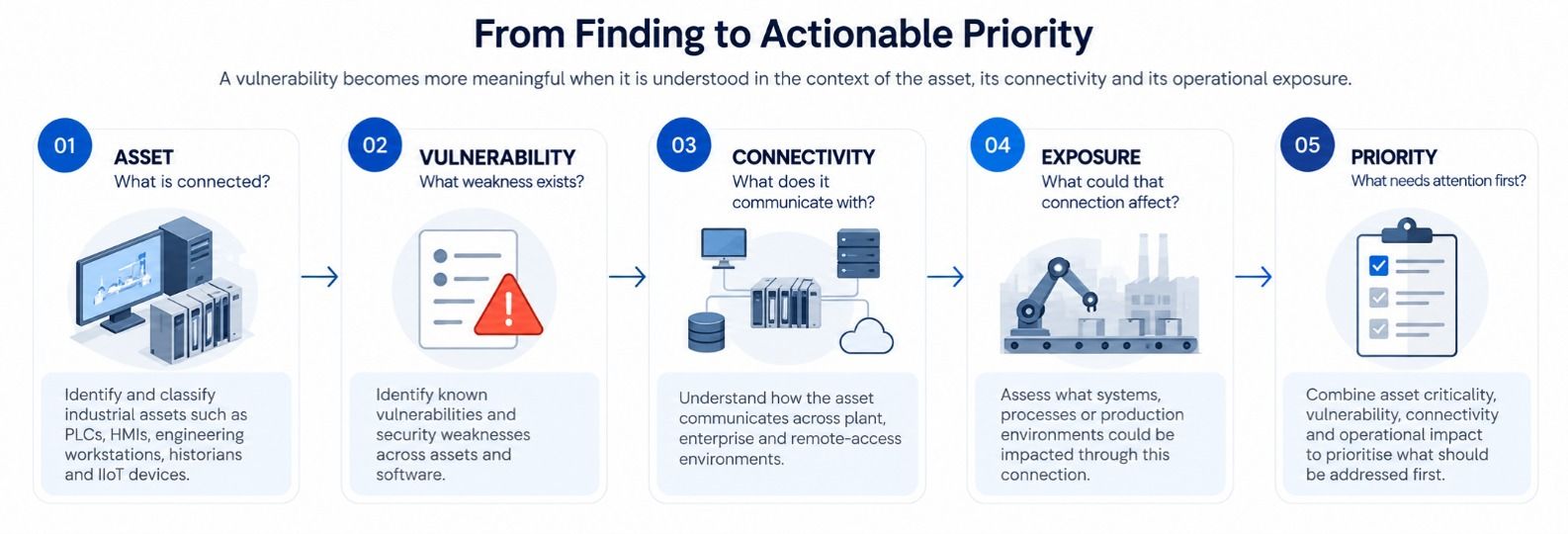
The vulnerability tells you what may be wrong. The environment tells you why it matters, and what should happen next. Without that linkage, security teams’ risk either over-reacting to low-impact findings or under-estimating the ones that sit on critical pathways.
What a Useful OT Security Assessment Must Reveal
A practical OT security assessment should do more than generate another long list of technical findings. It should help security and operations teams see the environment clearly enough to make defensible decisions.
It needs to answer a focused set of questions:
- What is actually connected across the industrial environment, and how should those assets be classified?
- Which vulnerabilities and security weaknesses exist?
- How do systems communicate, and where do they sit against the Purdue Model?
- Where are the segmentation, configuration or exposure gaps?
- Which findings carry real operational weight rather than theoretical risk?
- What should be prioritised, and why?
NIST SP 800-82 Rev. 3 is explicit that OT environments have distinct performance, reliability and safety requirements. Security decisions that ignore those constraints create their own operational risk. The objective is therefore not to discover every possible weakness in existence. It is to understand the environment well enough to separate technical noise from meaningful operational exposure.
Compliance Sets the Standard. Assessment Shows the Current State
Frameworks such as ISA/IEC 62443 and NIST SP 800-82 provide essential structure. They define what a well-secured industrial environment should look like and the processes organisations should follow. They do not automatically tell you what exists across a specific plant today, how systems are actually communicating, or where the gaps between policy and reality currently sit.
The useful progression is: Framework → Current State → Exposure → Priorities
Compliance establishes the framework. Assessment helps establish the current state. Together, they provide a stronger basis for deciding where security attention is required.
For UAE manufacturers modernising existing facilities, this becomes particularly relevant as legacy systems, new connected technologies, remote access and evolving IT/OT relationships increasingly coexist within the same industrial environment.
From Visibility to Prioritised Action with ZeroHack CVA
For manufacturers accelerating digital transformation, the first practical step is often not another permanent monitoring platform. It is a clear, operationally realistic view of the current environment, delivered in a way that respects production constraints and produces decision-ready output.
ZeroHack CVA (Compliance and Vulnerability Assessment) is designed for exactly this purpose. It provides a structured, non-intrusive assessment of IT, OT and IoT environments covering:
- Asset discovery and classification
- Vulnerability assessment
- Network visibility and communication-pattern analysis
- Security-gap analysis
- Purdue Model mapping
- Compliance alignment
- Prioritised reporting with actionable recommendations

ZeroHack CVA supports OT-aware data collection methods selected according to the sensitivity of the environment: passive monitoring via SPAN or mirror ports (zero packet injection), offline PCAP analysis, and carefully controlled active scanning. These approaches allow meaningful insight to be gathered while uptime and safety requirements are respected.
Findings are not left as raw technical lists. They are placed in operational context, mapped against relevant compliance expectations (including IEC 62443 and NIST SP 800-82), and prioritised so that security and operations teams can see what requires attention first and why.
Secure Industrial Transformation Starts with Visibility
The UAE is building a more connected industrial economy. As manufacturers adopt AI, robotics, Industry 4.0 and industrial IoT, their cybersecurity programmes need to evolve alongside that transformation.
The question is no longer simply: How many vulnerabilities do we have? It is: What do we have? Where does it connect? What is exposed? What matters most? And what should we address first?
Visibility is the beginning. Context is what makes it actionable.
Explore Your OT Exposure
Talk to WhizHack about a focused, non-intrusive ZeroHack CVA assessment for your industrial environment, structured for clarity, compliance alignment and actionable prioritisation.
Frequently Asked Questions
What is an OT cybersecurity assessment?
An OT cybersecurity assessment evaluates industrial assets, vulnerabilities, network relationships, security gaps and exposure while accounting for the performance, reliability and safety requirements of operational technology environments.
Why is OT cybersecurity important for UAE manufacturers?
The UAE is accelerating Industry 4.0, advanced technology adoption and digital transformation across manufacturing. As industrial environments become more connected, manufacturers need greater visibility into their assets, communication relationships and potential cyber exposure.
What is the difference between an OT assessment and a vulnerability scan?
A vulnerability scan primarily identifies technical weaknesses. An OT assessment adds operational context by considering assets, architecture, communication patterns, exposure, segmentation and the practical constraints of industrial environments.
What does ZeroHack CVA assess?
ZeroHack CVA assesses IT, OT and IoT environments across asset discovery and classification, vulnerability assessment, network visibility, security-gap analysis, Purdue Model mapping, compliance alignment and prioritised reporting.
Can an OT assessment be performed without disrupting production?
Yes. Depending on the environment, assessment methods can include passive monitoring through SPAN or mirror ports, offline PCAP analysis and carefully controlled active scanning. The appropriate approach is selected according to plant architecture, equipment sensitivity and operational requirements.